


Gifting Property in Israel: Legal Representation
A gift of real estate in Israel is a transfer of rights without consideration, or for nominal consideration that does not reflect market value. In practice it is often a parent-to-child apartment transfer, a transfer between spouses or relatives, or a partial transfer of rights. Even without a purchase price, the deal is governed by Israeli land law, contract law, and the Gift Law, as well as real estate tax rules and registration requirements.
Professional representation is meant to ensure that the undertaking is properly documented in writing, that the rights can actually be transferred, that conditions or rights of revocation are set in advance, and that registration is completed with the correct registry. The lawyer’s role is not limited to one form. Counsel manages the legal side of the gift from the early checks through completion of registration.
Sternberg & Co. Advocates represents clients in Israeli real estate transactions, including gifts. The firm’s civil and commercial litigation practice, including real estate and inheritance disputes, adds practical value: friction points can be spotted early, and the agreement can include clear tools that reduce later conflict. For a broader view of the firm’s real estate work, see Real Estate Lawyer Israel.

Gift Versus Sale Under Israeli Law
Calling a deal a “gift” is not enough. In a sale, substantial consideration moves from buyer to seller. In a gift, the right is given without consideration, or for consideration that does not reflect the value of the right. Misclassification can affect document drafting, tax reporting, and later claims between the parties or against third parties.
Sometimes parties label a transaction a gift even though real consideration is paid, or they waive consideration but expect sale-like mechanics. Counsel reviews the substance of the understandings, the paperwork, and the property and tax consequences, then matches the documents to the correct classification. Where the deal is an ordinary purchase for value, buyer-side representation is covered on Buying Property in Israel.
Stages of Gifting an Apartment in Israel
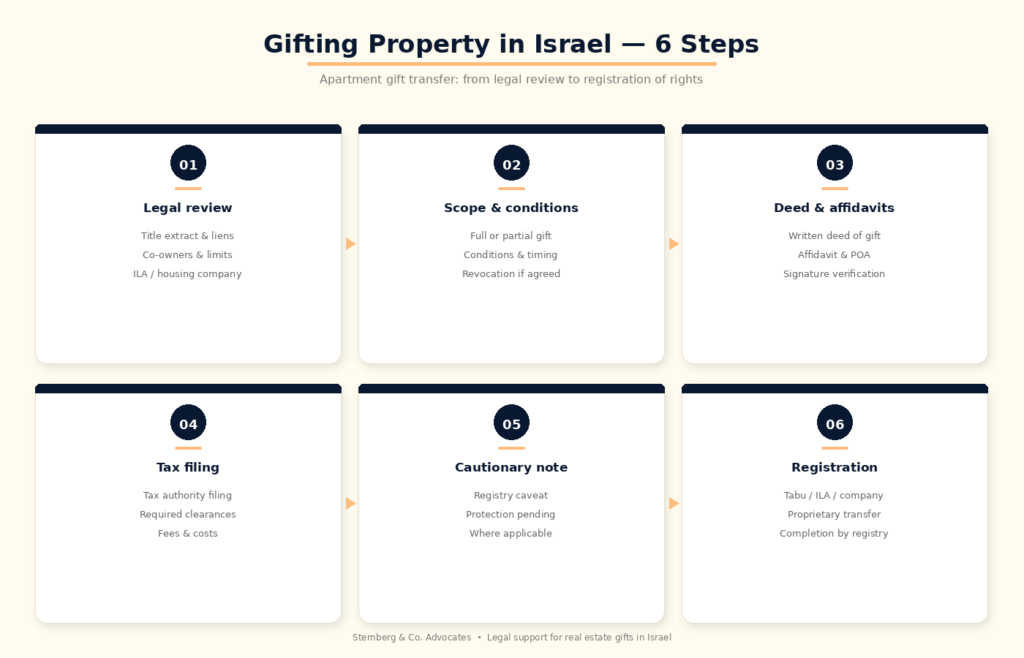
Gifting an apartment in Israel, or transferring apartment rights without consideration, usually proceeds in stages. Order and timing depend on the registration framework, mortgages or liens, the parties’ status, and whether the transfer is full or partial.
Typically the process includes:
- Legal review of the property and of the donor’s rights
- Agreement on the scope of the gift, conditions, and timetable
- Drafting a deed of gift or written undertaking and authenticating signatures
- Reporting to the Israel Tax Authority and obtaining required clearances
- Registration of a cautionary note (caveat), where the rights and circumstances allow it
- Completion of the transfer at the Land Registry (Tabu), the Israel Land Authority, or a housing company, as applicable
Each stage has independent legal weight. An undertaking to gift land rights must be in writing. Completion o
f the proprietary transaction generally occurs upon registration under the Land Law. Until registration is completed, what remains may be a contractual undertaking to make a transaction, not registered ownership.
Deed of Gift, Affidavits, and Written Undertakings
The deed of gift (or gift agreement) is the central document that records the undertaking. Under Israeli gift and land law, an undertaking to make a gift of land rights must be in writing. In practice the file often includes a gift agreement, affidavits, powers of attorney, and transfer forms required for registration.
A carefully drafted deed of gift may address, among other matters:
- Identity of the parties and the scope of rights gifted
- Whether the gift is immediate or conditional
- Suspensive or resolutory conditions
- The donor’s right of revocation, if the parties wish to reserve one
- Representations about registration status, liens, and third parties
- Responsibility for releasing a mortgage or other limits before registration
- Allocation of tax filings, fees, and expenses
- Delivery of possession, where possession changes
- How registration will be handled and how tasks are divided between counsel
There is no single form that fits every case. A parent-to-child transfer raises different issues from a transfer between siblings or a partial transfer to a spouse. Drafting should reflect the real intent and reduce ambiguity that can fuel later disputes.
Gifting Israeli Property from Abroad: POA, Apostille, and Remote Signing
Many foreign residents gift or receive Israeli property without traveling for every step. Israeli practice commonly allows a party to grant a power of attorney so counsel in Israel can sign transfer documents, handle filings, and coordinate clearances. Documents signed abroad often require notarization and an apostille or other authentication, depending on the country and the receiving authority in Israel.
Remote gifts also require planning around:
- Identity verification and KYC requirements for Israeli lawyers and, where relevant, banks
- Timing of signatures across time zones
- Escrow or trust arrangements for original documents
- Who holds keys and access if possession is transferred
- How any related funds (for example costs, arrears, or mortgage payoff) will move, if applicable
Bank compliance can delay related transfers into or out of Israel. Parties who encounter remittance friction may find related analysis in Funds Stuck in an Israeli Bank. The gift documents and timetable should be drafted with those practical constraints in mind.
Family Gifts and Parent-to-Child Transfers
Parent-to-child apartment gifts are among the most common gift transactions. Sometimes the transfer is complete; sometimes only a share is gifted and co-ownership remains. In other cases the gift is between spouses, between siblings, or part of a broader family arrangement.
In family gifts it is important to review in advance:
- Whether all registered right-holders are parties (including a spouse, where required by the applicable law)
- Whether heirs or other relatives may later challenge the transfer
- Whether the donor should retain a right of residence, use, or revocation
- How the gift interacts with succession planning and wills
- Whether the gift will create co-ownership that later needs regulation or dissolution
A lifetime gift differs from a transfer by inheritance. Where the goal is arrangement after death, a will and estate procedures should be examined rather than relying on a “gift that takes effect only after death” in place of a proper succession process. See Israeli Inheritance Lawyer and Wills in Israel. Foreign residents planning succession for Israeli assets may also find context in Why Foreign Residents Need Wills in Israel. Where a dispute already exists around gifts or an estate, see Inheritance Disputes in Israel.
If several owners remain after the gift, co-ownership dissolution may arise later. See Dissolve Property in Israel.

Conditions, Revocation, and Cancellation of a Gift
A gift is not always absolute and immediate. The parties may agree on conditions, dates, and circumstances in which the donor may revoke, subject to Israeli law. After the gift is completed by registration, cancellation options narrow and change. Disputes about revocation, undue influence, or capacity may reach court.
To reduce risk, the agreement should address:
- Whether the gift is revocable and on what terms
- What happens if the donee fails to perform a related undertaking
- How liens or debts arising after the undertaking and before registration are handled
- Remedies in case of breach or dispute
Clear drafting at the undertaking stage is better than trying to repair the position after family or commercial relations have already broken down.
Legal Due Diligence Before a Transfer Without Consideration
Before transferring an apartment without consideration, lawyers should run checks similar to those used in a sale, even when the parties are relatives who trust one another. The goal is to confirm which rights are being transferred, where they are registered, and what limits may delay registration or create exposure.
Checks may include:
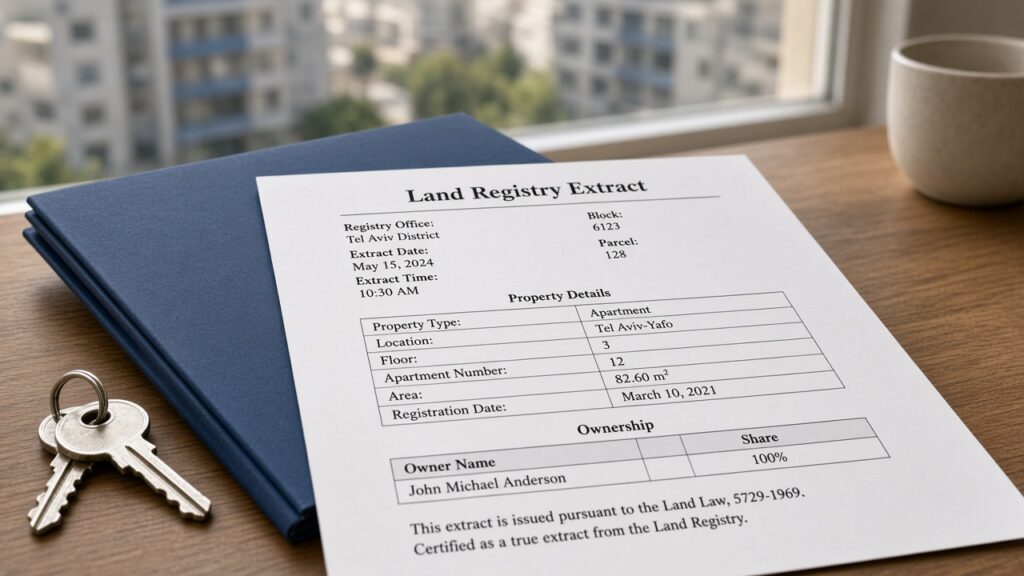
- An updated Land Registry extract (Tabu)
- Identity of right-holders and the scope of their rights
- Cautionary notes, mortgages, attachments, and other liens
- Rights at the Israel Land Authority or through a housing company
- Condominium order, bylaws, and registered attachments
- Personal documents and consents required from a spouse or co-owners
- Preparation for tax filings and clearances needed for registration
These legal checks do not replace engineering or planning inspections where the donee needs them. They do allow accurate representations and planning for removal of obstacles before the registration date.
Cautionary Note (Caveat) in a Real Estate Gift
Where rights are registered at Tabu and the written undertaking supports it, counsel often considers registering a cautionary note in favor of the donee after signing and before final registration. The note reflects the undertaking on the registry and helps protect against conflicting transactions.
A cautionary note does not transfer ownership and does not replace registration of the rights. Its use in a gift depends on the registration framework and the facts. For a fuller explanation, see Caveat Registration and Conflicting Transactions in Israel.
Registering Gifted Rights at the Land Registry
The final stage is completing the transfer of rights into the donee’s name with the relevant registry. A gift agreement creates a contractual framework. Under the Land Law, a land transaction generally requires registration and is completed upon registration.
Documents and clearances that may be required include:
- Signed and duly authenticated transfer deeds or forms
- Real estate tax clearances for registration
- Municipal clearance where required by law
- Powers of attorney and identification documents
- Mortgage or lien release documents, where relevant
- Further documents required by the body that administers the rights
Who files the registration is set in the agreement and by how the parties’ lawyers work together. There is no uniform rule that one side always submits the application. Counsel ensures that the side represented performs on time and that the required documents are ready.
Tax Considerations in a Real Estate Gift in Israel
A gift of real estate in Israel is subject to the Real Estate Taxation Law. As a rule, the parties must report the transaction to the tax authority within the statutory period. The donee may be liable for purchase tax; in some family transfers, special rules or reliefs may apply, depending on the conditions and the date of the deal. On the donor’s side, capital gains issues or exemptions may arise according to the property and the donor’s circumstances.
Rates, brackets, and eligibility conditions change. Tax liability must be reviewed under the law and the facts current at the time of the transaction, not under general assumptions. This short section does not replace case-specific tax advice.
Legal Risks in Israeli Property Gifts
A gift can look simple because no purchase price installments are flowing, yet it can create substantial legal risk:
- Liens or attachments that block registration
- Missing consent of a spouse or co-owner
- Vague drafting of conditions or revocation rights
- Claims by heirs or other relatives
- Delay in tax or municipal clearances
- Disputes over whether the deal is a gift or a disguised sale
- Difficulty cancelling after registration is completed
Where a dispute has already arisen, the firm also represents clients in civil and commercial litigation, including real estate and gift-related conflicts.
Frequently Asked Questions
Do I need a written deed of gift for Israeli property?
An undertaking to gift land rights must be in writing. Beyond the statutory requirement, a clear agreement protects both sides and reduces disputes about scope and conditions.
Can a foreign resident gift an Israeli apartment without traveling to Israel?
Often yes, through a properly drafted power of attorney and authenticated documents (commonly notarization and apostille). Feasibility depends on the property, the registry framework, and how possession and originals will be handled. Counsel should map the practical path before signatures begin.
Is a parent-to-child apartment gift exempt from tax?
Not necessarily. Special rules or reliefs may apply in some cases, but they depend on the law, the family relationship, the type of right, and the facts of the deal. Each case must be reviewed at the time of transfer.
When is ownership transfer completed?
As a rule, the proprietary land transaction is completed upon registration with the relevant registry. Signing an agreement does not replace registration.
Who files the registration after a gift?
It depends on the agreement and on cooperation between the lawyers. Counsel for each side ensures that side’s documents, signatures, and clearances are completed on time.
Legal Representation for Gifting Property in Israel
Sternberg & Co. Advocates represents donors and donees in gifting property in Israel: from legal review of the rights, through drafting the deed of gift and setting conditions and revocation terms, handling cautionary notes and tax filings, through accompanying the parties in completing registration of the rights.
Combining transactional real estate experience with litigation and inheritance-dispute work allows the firm to review the gift also from the perspective of future conflicts, and to act already at the contractual stage to reduce them.
Main real estate practice page: Real Estate Lawyer Israel. Purchase for value: Buying Property in Israel.
Planning to gift an apartment in Israel, or to receive one as a foreign resident? It is advisable to seek legal representation before signing any undertaking or affidavit. To schedule an initial consultation, contact us.