


Money that has sat untouched in an Israeli bank for years can become surprisingly difficult to move. A client who deposited or transferred funds long ago, and who now simply wishes to withdraw the money or transfer it back to an account abroad, increasingly meets a wall of documentation requirements rather than a routine transfer. Following successive tightenings of Israel’s anti-money laundering regime, the bank may decline to release funds whose origin was never questioned at the time they were received. For account holders living abroad, who often cannot attend the branch or follow correspondence in Hebrew, the result is money that is, in practical terms, frozen in place. Resolving this is one of the matters handled by our civil and commercial litigation practice.
This article reviews why Israeli banks restrict the release and transfer of funds under the anti-money laundering framework, the typical scenarios in which long-dormant money becomes stuck, why a refusal of this kind is a complex legal process rather than a clerical hurdle, the limits of what a bank may lawfully demand, and the role of legal representation in examining the bank’s conduct and the courses of action that may be available. For clients abroad in particular, who cannot monitor the account from a distance, understanding this mechanism is essential.
Why Israeli Banks Restrict the Release of Funds
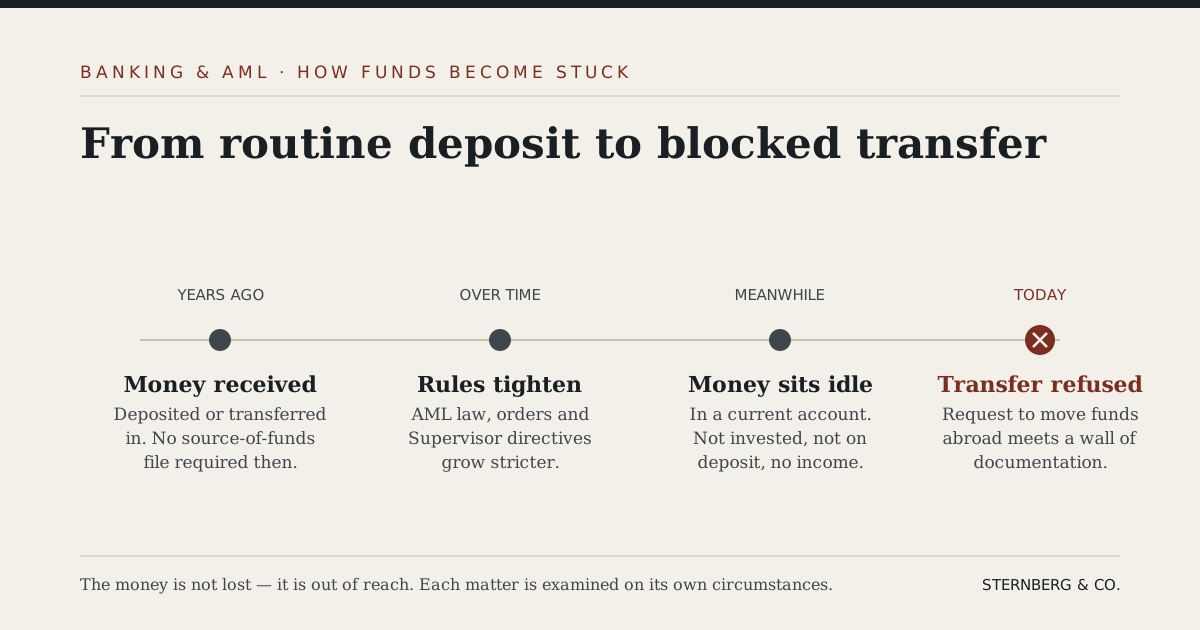
The framework is set by the Prohibition on Money Laundering Law, 5760-2000, the orders issued under it, and the directives of the Supervisor of Banks. Together these impose identification, “know your customer” and due diligence obligations on banking corporations, obligations that have been tightened considerably over the years. In practical terms, a bank asked to transfer funds abroad is expected to be able to trace their origin, even where the money was deposited many years earlier, and where the bank is not satisfied, it may decline to execute the transfer.
It is important to understand the nature of this situation. The bank is not asserting that the money is unlawful; in the great majority of cases the funds are entirely legitimate. The difficulty is evidentiary and procedural: the client is asked, often with little notice, to reconstruct the origin of funds received long ago, to a standard that did not exist when the account was opened. The money frequently sits in a current account, not invested, not held in any deposit and generating no income, while its owner can neither withdraw it, transfer it, nor put it to use.
The Typical Scenarios
Although each matter turns on its own facts, the situations that reach our firm tend to fall into a number of recurring patterns:
- Funds transferred years ago that cannot be moved out today. Money transferred to Israel or deposited in an account many years ago, at a time when the bank required no comprehensive source-of-funds documentation. Today, when the client asks to transfer the funds back to an account abroad, the bank retroactively requests proof dating back a decade or more: documents that have been lost, institutions that no longer exist, and at times depositors who are no longer alive.
- Inheritance funds that heirs abroad wish to receive. Heirs living abroad seek to have funds transferred to them from the deceased’s Israeli account, and the bank declines, both over the source-of-funds question and in the absence of an inheritance order or probate order. These two tracks are often handled in parallel, as part of our Israeli inheritance law practice.
- Proceeds from the sale of Israeli property that cannot be transferred abroad. Foreign residents who sold an apartment or property in Israel seek to transfer the proceeds to their account abroad, and the bank holds the transfer pending documentation of the property, its historical funding sources and the required tax certificates. These questions frequently intersect with the work of a real estate attorney in Israel.
- Old and dormant accounts. Accounts opened decades ago, sometimes by family members, in which activity has long ceased. When the holder seeks to consolidate the funds and transfer them abroad, the bank sets requirements that are very difficult to meet after so much time has passed.
A Complex Legal Process, Not a Clerical Hurdle
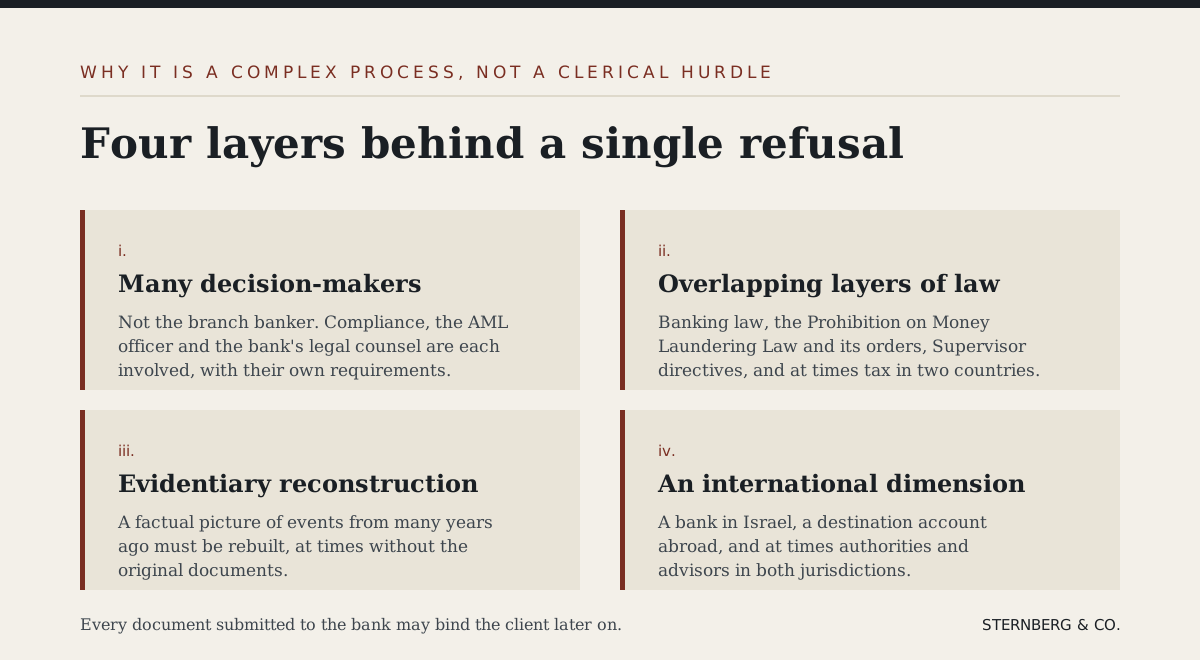
It is important to understand that releasing stuck funds is not a matter of filling in a form or speaking with the branch. It is a complex process, combining several dimensions at once.
First, the decision does not rest with the banker at the branch. It involves the bank’s compliance department, the officer responsible for the corporation’s obligations under the anti-money laundering law, the bank’s legal counsel and at times additional functions, each with its own considerations and requirements. Second, several layers of law operate in parallel and affect one another: banking law, the Prohibition on Money Laundering Law and the orders issued under it, the directives of the Supervisor of Banks, and at times tax aspects in Israel and in the destination country. Third, the matter is evidentiary in nature: a factual picture of financial events from many years ago must be reconstructed, at times without the original documents, in a manner capable of satisfying the bank and, where necessary, the court. Finally, there is usually an international dimension, involving a bank in Israel, a destination account abroad, and at times authorities and advisors in both countries.
One further point should be borne in mind: every document submitted to the bank, and every explanation given to it, may bind the client later on. Precisely because of this complexity, structured professional representation from the early stages may carry real weight.
The Limits of What a Bank May Demand
A bank’s discretion in these matters is broad, but it is not unlimited. A banking corporation is subject to obligations under law, and its refusal to provide a service is expected to meet the standards of reasonableness and proportionality developed in legislation and case law. A demand may, in appropriate circumstances, be examined against what can fairly be expected of a client seeking to document events from many years earlier, particularly where the original records are no longer obtainable through no fault of the client.
This is the point at which legal representation becomes relevant. Familiarity with Israeli banking law and with the scope of the bank’s duties allows the demands actually made to be assessed, and a professional dialogue to be conducted with the bank’s legal and compliance departments, in their language and according to their conventions. Where a refusal appears unjustified or disproportionate in the circumstances, the courts may, in appropriate cases, be asked to examine the bank’s conduct. A litigation orientation also informs the management of that dialogue well before any proceeding is commenced. Every matter is assessed on its own facts, and the available courses of action depend on its circumstances; the assessment and the specifics of its handling take place within an individual consultation.
The Cross-Border Dimension
Where the client lives abroad, the matter almost always carries an additional layer. The funds sit with a bank in Israel, while the destination is an account in another country, and the documentation that may assist, tax records, sale agreements, inheritance documents and historical statements, is frequently spread across two jurisdictions. Coordination with the client’s advisors in their home country, and management of the interface with the destination account, may form part of the work, including within the framework of our corporate practice serving foreign clients and investors. For clients who cannot attend in Israel, much of this is handled through powers of attorney prepared and authenticated in advance.
Conclusion: Money That Is Present but Out of Reach
Funds stuck in an Israeli bank present a particular kind of difficulty: the money is not lost, it is simply out of reach, sitting in an account while its owner is unable to use it. The passage of time, the tightening of the anti-money laundering regime and the absence of records that were never thought necessary combine to turn a routine transfer into a contested matter. Whether the route ultimately runs through documented dialogue with the bank or through the courts depends entirely on the circumstances of the specific case, and on a careful examination of both the funds and the bank’s conduct.
Sternberg & Co. Advocates is a boutique law firm in Israel that represents private and international clients in complex civil, commercial, real estate and inheritance matters, including clients abroad whose funds are held in Israeli banks. Contact us to schedule an initial consultation (subject to a conflict and suitability check).
En français : fonds bloqués dans une banque en Israël
Vos fonds sont bloqués dans une banque en Israël et la banque refuse de les transférer vers la France ? Il s’agit d’une situation fréquente : des sommes transférées ou déposées il y a des années qui, à la suite du durcissement de la loi anti-blanchiment israélienne, ne peuvent plus être retirées ni rapatriées sans des justificatifs d’origine qui n’étaient pas exigés à l’époque du dépôt. Bien souvent, ces fonds stagnent sur un compte courant, ni investis, ni placés, ne produisant aucun revenu, tandis que leur titulaire ne peut ni les retirer, ni les transférer, ni en disposer.
Comme expliqué ci-dessus, débloquer un compte bancaire en Israël n’est pas une simple démarche administrative mais une procédure juridique complexe : il faut notamment justifier l’origine des fonds auprès de la banque israélienne, y compris pour des dépôts effectués il y a de nombreuses années, parfois en l’absence des documents d’origine. Ces situations concernent fréquemment des fonds successoraux que des héritiers en France souhaitent recevoir, ou le produit de la vente d’un bien en Israël qu’un résident français cherche à rapatrier. Le refus de la banque doit néanmoins satisfaire aux critères de raisonnabilité prévus par le droit israélien, et chaque dossier est examiné selon ses circonstances propres.
Sternberg & Co., cabinet d’avocats boutique en Israël, intervient, parmi ses autres domaines d’activité, dans le déblocage de fonds retenus par les banques israéliennes et dans les problématiques issues de la loi anti-blanchiment. Pour une évaluation juridique confidentielle, vous pouvez nous contacter à office@strn.co.il ou au +972-2-6746746.
The above constitutes general information only, current as of its date of publication, and does not constitute legal advice or a substitute for advice based on the full circumstances of a specific matter. No action should be taken, or avoided, in reliance on the above.