


Most real estate transactions in Israel reach a successful conclusion: the consideration is paid, possession is delivered, and rights are registered. But not all of them. A seller who has second thoughts after prices rise, a buyer whose financing has collapsed, a persistent delay in delivery, or representations that prove inaccurate, any of these can turn a routine transaction into a legal dispute centered on an asset worth a fortune to the parties. In such a situation a swift and informed decision is required among three principal paths: specific performance of the agreement, its rescission, or a claim for damages, and at times a combination of them. The choice is not merely legal but strategic, and it is among the more complex questions that an experienced litigation-minded real estate attorney helps navigate.
This article reviews what constitutes a breach of a purchase agreement and what constitutes a fundamental breach, the remedies available to the injured party under Israeli law, the common scenarios of breach in apartment sale transactions, the interim remedies required to protect one’s rights during a dispute, and also the preventive dimension: how proper drafting of the agreement in the first place largely determines the outcome of the litigation, should it erupt.
What is a breach of a purchase agreement, and what is a fundamental breach?
An apartment purchase agreement is a contract in every respect, and the law governing its breach is found primarily in the Contracts (Remedies for Breach of Contract) Law, 5731-1970. A breach is any act or omission contrary to the provisions of the contract: late payment, failure to deliver possession on time, failure to discharge a mortgage, failure to furnish the documents required for registration, and more.
The central distinction in the law is between an ordinary breach of a purchase agreement and a fundamental breach: a breach of which it may be assumed that a reasonable person would not have entered into the contract had they foreseen it and its consequences, or a breach that the parties agreed in advance to treat as fundamental. This distinction carries decisive practical significance, chiefly with respect to the right of rescission and to the agreed compensation. In purchase agreements it is customary to set out a list of provisions whose breach will be deemed a fundamental breach, among them the consideration clauses, the delivery date, and the transfer of rights. Drafting this list is one of the points at which the balance of power in a future dispute is fixed in advance: a list that is too broad may turn every technical delay into grounds for rescission, while a list that is too narrow may leave the injured party without any real leverage.
The law further recognizes an anticipatory breach: where it becomes clear, even before the time for performance, that a party does not intend or is unable to fulfill its obligations, the other party may rely on its remedies already at that stage, without waiting for the actual time of breach. In real estate transactions, which involve long timelines, this rule is of considerable practical importance.
The three remedies: specific performance, rescission, and damages
Specific performance of the agreement
Unlike other legal systems, in which damages are the primary remedy, under Israeli law specific performance is the remedy of first resort, and this is especially true in real estate: every asset is considered unique, and money is no substitute for the specific apartment that was purchased. A party injured by a breach may petition for an order directing the breaching party to fulfill its obligations, including completing the transfer of rights, delivering possession, or signing the required documents; and in appropriate cases the court will even authorize a person on its behalf to sign in place of a refusing party.
The right to specific performance is not absolute, and the law sets out exceptions to it, among them a contract that is not capable of performance and situations in which enforcement would be unjust in the circumstances. In practice, in apartment sale disputes, the defenses often focus on the question of who breached first, whether the breach is fundamental, and whether the injured party itself acted in good faith and fulfilled its own obligations. These questions are decided on the basis of the evidence, and so the manner in which the parties documented their conduct during the transaction carries decisive weight.
Rescission of the agreement and restitution
The rescission path is the other side of the coin. Where the breach is fundamental, the injured party may rescind the contract by notice of rescission within a reasonable time; where the breach is not fundamental, it must first grant an extension for performance, and only if the breach is not cured within it may the contract be rescinded, subject to considerations of justice. Rescission entails a duty of mutual restitution: each party returns what it received, first and foremost the return of payments made.
It is important to understand that rescission is not a technical step but one fraught with risk: an unlawful rescission, for example on account of a non-fundamental breach of a purchase agreement without an extension, or a notice of rescission given late or in defective form, may itself be deemed a fundamental breach by the party rescinding, with all that this entails. This is one of the junctures at which a hasty decision, taken without legal guidance, turns an injured party into a breaching party.
Damages and agreed compensation
Alongside specific performance or rescission, and cumulatively with them under the conditions prescribed by law, the injured party is entitled to compensation for the loss caused to it as a result of the breach and which the breaching party foresaw or ought to have foreseen. The injured party bears a duty to mitigate the loss, and is required to act reasonably to minimize it.
In apartment purchase agreements it is customary to stipulate agreed compensation: a sum fixed in advance, generally derived from the value of the transaction, payable for a fundamental breach without any need to prove loss. This tool provides certainty, but it too is not immune: the court is empowered to reduce agreed compensation fixed without any reasonable proportion to the loss that could have been foreseen, at the time of contracting, as a probable consequence of the breach. Alongside the agreed compensation, grounds may arise for compensation for proven losses, among them differences in value, financing costs, and alternative rent, all subject to the circumstances and the evidence. In the purchase of a new apartment, the Sale (Apartments) Law establishes a dedicated arrangement for compensation for late delivery, applicable under the conditions set out therein.
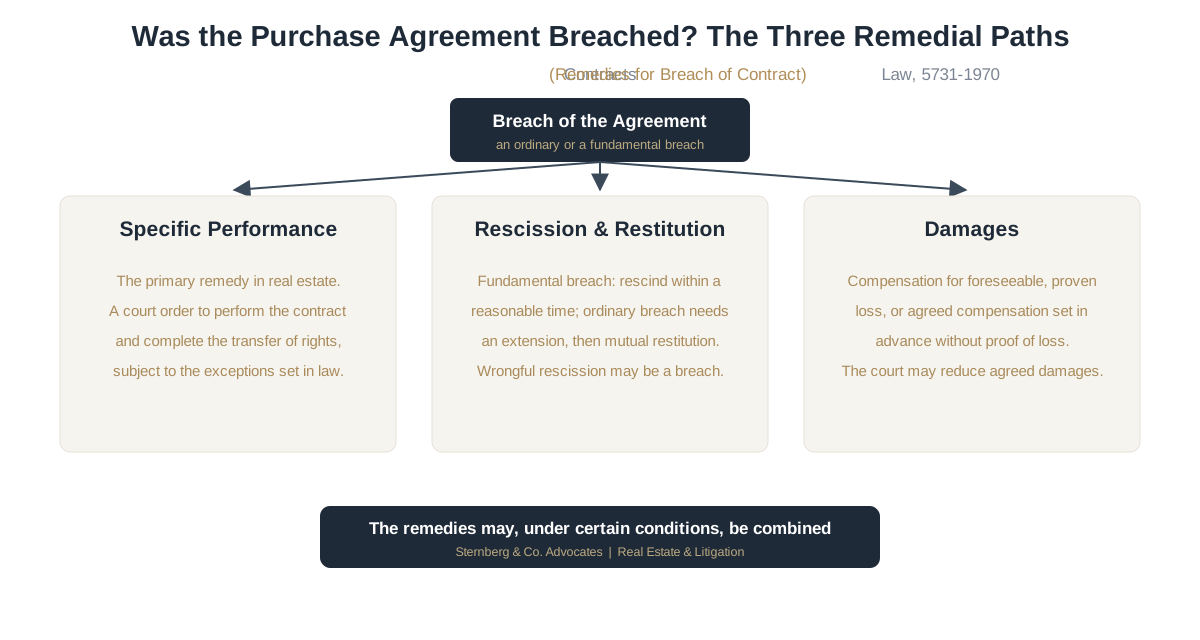
This diagram provides general information only and does not constitute legal advice. The applicable remedies depend on the agreement, the circumstances of the breach and applicable law.
Common breach scenarios in sale transactions
- Breach by the buyer: failure to meet payments. The most common scenario, usually against the backdrop of financing difficulties, a delay in the mortgage, or a delay in selling an existing property. From the seller’s perspective, the practical question is when a delay becomes a fundamental breach conferring the right to rescind and to collect the agreed compensation; from the buyer’s perspective, how the breach can be cured within the extension so as to salvage the transaction.
- Breach by the seller: refusal to complete the transaction. From this scenario grow the classic specific-performance claims, often against the backdrop of a rise in prices between signing and delivery, or a higher offer from a third party. Here too the issues of conflicting transactions and the caveat come into play, on which we have expanded in our article: Caveat in Israel and conflicting transactions.
- Delay in delivering possession, in both second-hand apartments and contractor-built apartments, with its implications: alternative rent, storage costs, and agreed or statutory compensation.
- Failure to discharge a mortgage or encumbrances by the dates set, in a manner that delays the registration of rights and exposes the buyer.
- Breach of representations: undisclosed building violations, material defects in the property, hidden debts, or a discrepancy between the planning status and what was declared. These scenarios raise, alongside the law of remedies, also questions of misrepresentation and the duty of disclosure at the pre-contractual stage.
- Breaches surrounding preliminary documents. Even a memorandum of understanding may give rise to full contractual liability, and a party withdrawing from it may find itself sued. On this matter see: Can a memorandum of understanding become a binding contract?
Interim remedies: protecting the asset in real time
In a sale dispute, time works against the injured party: an asset can be sold to a third party, funds can disappear, and the registration status can change. Therefore, alongside the main claim, an immediate application for interim remedies is often required: an injunction prohibiting any disposition of the asset, a temporary attachment on the asset or on funds, and orders to secure registration. A buyer in whose favor a caveat is registered enters the litigation from a significantly stronger position, since the caveat blocks the registration of conflicting transactions even before the court is called upon to address the matter; and one who did not register a caveat in time may find that the interim remedy is the last remaining line of defense.
Interim-remedy proceedings are characterized by urgency and by special evidentiary requirements, in which questions of the balance of convenience, clean hands, and delay are examined. Their proper handling, already in the first hours and days of the dispute, frequently influences the final outcome more than any other stage of the proceeding.
Discovered a breach? The first practical steps
The hours and days following the discovery of a breach, or the concern of an approaching breach, are critical, and what is done in them bears upon the entire proceeding to follow. The recommended order of action:
- Immediate documentation. Gathering all the correspondence, notices, supporting documents, and payments related to the transaction, and insisting from that moment onward on communication in writing only. In sale disputes, the better-documented party begins the proceeding with a considerable advantage.
- Checking the registration status. Obtaining an up-to-date Land Registry extract (nesach tabu) or confirmation of rights, to detect changes: new caveats, attachments, or an attempt to advance a conflicting transaction. The findings directly affect the urgency of applying for interim remedies.
- Refraining from unilateral steps. Do not send a notice of rescission, stop payments, or refuse to perform obligations without legal advice. A wrong step at this stage may turn the injured party into a breaching party, and shift the balance of power to the other side.
- A professional warning letter. A duly drafted communication that puts the breaching party on notice of its breach, sets an extension where the law so requires, and preserves the full range of rights and remedies. The warning letter is not a matter of generic wording: it is a legal document that will later be read by the court, and it is built even now as evidence.
- Formulating a strategy before acting. A considered decision among the paths of specific performance, rescission, and damages, on the basis of the evidence, the registration status, and the other party’s ability to pay.
It is worth remembering that even after a breach, a considerable portion of disputes ends in settlement: cure of the breach within an extension, an update to the payment or delivery schedule, or a monetary compromise. Negotiation conducted from an established position of legal strength, and at times in the shadow of a proceeding already commenced, almost always yields a better result than an approach made from weakness and without preparation.
And what if you are the party accused of breach?
Not everyone labeled a “breaching party” has in fact breached, and not every breach justifies the outcome the other side seeks to derive from it. The defending party too has substantive defenses: the existence of a condition precedent that was not fulfilled, a prior or concurrent breach by the other side, frustration, an unlawful rescission, excessive agreed compensation subject to reduction, contributory fault of the injured party, and breach of the duty to mitigate the loss. In many scenarios, what was presented as an unequivocal breach turns out to be a genuine interpretive dispute over the provisions of the agreement.
Here too, the timing of the response is decisive: ignoring a warning letter or an interim-remedy proceeding may entrench facts, whereas a professional and swift response that puts forward a documented counter-version frequently alters the course of the entire dispute. Representation on the defending side is not merely a defense: at times it includes a counterclaim for the losses caused by the other party’s conduct.
The preventive dimension: the contract is the first line of defense
Most sale disputes are decided, ultimately, on the basis of the contractual text drafted months or years earlier: the definition of the fundamental breaches, the mechanisms for extensions and notices, the amount of the agreed compensation and its conditions, the trust and power-of-attorney mechanisms, and the representations and disclosure clauses. This is why our firm’s approach, which integrates dispute-oriented thinking already at the transaction stage, translates into contractual drafting tested by a single question: how will this clause hold up under the test of litigation. Accompanying a transaction with this approach is an integral part of legal representation in purchasing an apartment, and for a review of the entire course of the transaction see: How to purchase real estate properties in Israel.
And when the dispute has already erupted, the choice of path, specific performance, rescission, or damages, must be made with a cool head and as part of an overall strategy: assessing the evidence, the registration status, the financial robustness of the other party, the costs and duration of the proceeding, and the true value of the alternatives. Our firm represents buyers and sellers in purchase-agreement disputes within the framework of the firm’s civil and commercial litigation practice, from the pre-litigation stage and warning letters through to the conduct of the proceeding and appeal.
Summary
A breach of an apartment purchase agreement places the injured party at a crossroads of decisions in which every path carries a price and a risk: specific performance that demands stamina, rescission that entails legal risk if carried out unlawfully, and damages whose scope depends on the drafting of the contract and on the evidence. Three practical rules emerge from experience: document every stage of the transaction in writing; take no unilateral step, and certainly not a notice of rescission, without legal advice; and act as quickly as possible once a concern of breach arises, since interim remedies and opening positions are determined in the first days.
Sternberg & Co. Advocates accompanies buyers, sellers, and developers in real estate transactions and represents clients in purchase-agreement disputes, including claims for specific performance, rescission, damages, and interim remedies. To arrange an initial consultation, contact us (subject to a suitability check).
The foregoing constitutes general information only and does not constitute legal advice or a substitute for individual advice based on the full circumstances of the case. One should not rely on the foregoing for the purpose of taking or refraining from any action.