


Why Buying from a Developer Differs from Any Other Property Transaction
Buying an apartment from a developer is not like buying an existing (second-hand) property in Israel. In an ordinary transaction, the buyer examines an existing, registered, completed asset and pays the price against possession and transfer of rights. When buying from a developer, by contrast, the buyer pays substantial sums – sometimes over several years – for an apartment that has not yet been built, or whose construction has not yet been completed. The rights in the land are not yet registered in the buyer’s name, the apartment is defined by plans and a technical specification, and the delivery date depends on the progress of construction and on factors beyond the buyer’s control.
This gap in timing and bargaining power is what underlies the unique legislative framework in this field: the Sale (Apartments) Law, 1973, which regulates, among other things, the mandatory technical specification, the warranty (bedek) periods and the compensation for late delivery; and the Sale (Apartments) (Assurance of Investments of Apartment Purchasers) Law, 1974, which obligates the seller to provide a security for the buyer’s money. Most of these provisions are mandatory (cogent) – meaning they cannot be contracted out of, except in the buyer’s favor.
And yet, even a protective legislative framework is no substitute for due diligence and legal representation. The law sets a floor – but it does not check the developer for you, does not read the contract, does not compare the specification against the sales promises, and does not monitor whether the securities are actually delivered.
The Common Mistake: “There Is Already a Lawyer in the Deal – the Developer’s Lawyer”
Many buyers mistakenly assume that the developer’s lawyer – whose fee (for registration of title) they are required to pay, in an amount capped by regulations – represents them as well. That is not the legal reality. The developer’s lawyer represents the developer alone, and their role toward the buyer is essentially limited to the registration formalities. The sale contract is drafted by the developer’s counsel, naturally in terms favorable to the developer, and frequently includes mechanisms for postponing delivery dates, broad rights for the developer to make changes, limitations of liability, high default interest charged to the buyer, and waiver clauses. For buyers who do not read Hebrew – the language in which these contracts are almost always drafted – the imbalance is even greater.
Turning to a lawyer of your own only after signing, or only once a problem arises – late delivery or construction defects, for example – significantly narrows the room for action. After signing, one can usually still rely on the mandatory provisions of the law, but it is far harder to fix contractual terms that could have been improved in negotiation. The core value of legal representation when buying from a developer lies precisely in the pre-signing stage – including before signing a purchase request, registration form or memorandum of understanding (zichron dvarim), documents that may carry binding legal effect.
Pre-Signing Due Diligence on a Developer Sale Contract
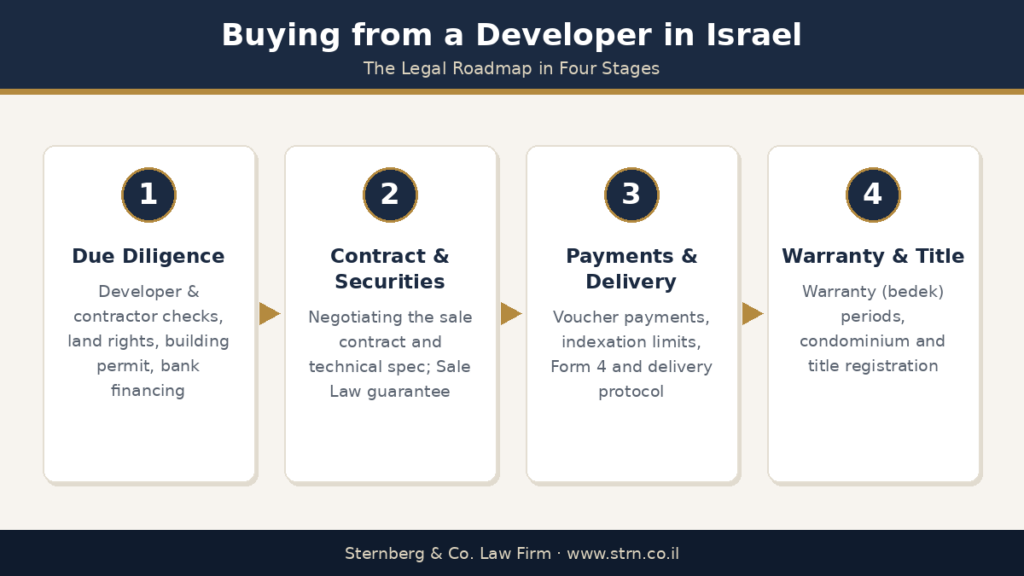
Checking the Developer and the Contractor
The first check concerns the party you are contracting with: who the developer is and who the performing contractor is, their track record in previous projects, whether material legal proceedings are pending against them, and whether the contracting structure is with the project company, the parent company or another entity. In projects where the developer is a special-purpose vehicle (SPV), this has a direct bearing on the quality of the securities required.
Checking the Land Rights and Planning Status
In parallel, the rights in the land are examined: a Land Registry (Tabu) extract or a rights confirmation from the Israel Land Authority, charges, mortgages and cautionary notes, as well as the planning status – whether a building permit has been issued for the project and what it covers, which plans apply to the land, and whether there are gaps between the marketing representations made to the buyer and the actual planning status. Signing a contract to purchase an apartment in a project that has not yet received a building permit requires explicit contractual treatment, including exit and refund mechanisms.
Bank Financing and the Project’s Funding Structure
It must be clarified whether the project is under closed bank accompaniment (financing) or accompanied by another financial institution, and the identity of the accompanying entity. The existence of bank accompaniment has a direct effect on the type of security the buyer will receive and on how payments are made, as detailed below.
The Sale Contract and the Technical Specification – What Is Actually Reviewed
A developer sale contract is a long and complex document, accompanied by numerous annexes: a technical specification under the Sale (Apartments) Order, sale plans, a payment schedule annex, a changes annex, powers of attorney and more. Among the central issues examined as part of the legal review (a non-exhaustive list):
- Conformity of the technical specification and plans with specific promises made at the marketing stage, and review of “permitted changes” clauses allowing the developer to deviate from the specification;
- The contractual delivery date and its postponement mechanisms – including clauses extending the delivery date in various circumstances, and their compliance with the law;
- The payment schedule, the indexation mechanism and the default interest applying to the buyer;
- Provisions concerning condominium registration and registration of title, including timetables and the developer’s undertakings;
- Termination, breach and liquidated damages clauses – and the degree to which they are reciprocal;
- Attachment of parking, storage and other appurtenances to the apartment, and common areas excluded from the common property;
- Custom changes and buyer modifications – costs, timetables and effect on the delivery date.
It is important to understand: even when a developer presents the contract as a “standard form contract that cannot be changed,” in practice there is often room for negotiation – certainly regarding the annexes, the dates, the specification and the correction of clauses that deviate from the law.
Securities Under the Sale Law – Protecting the Buyer’s Money
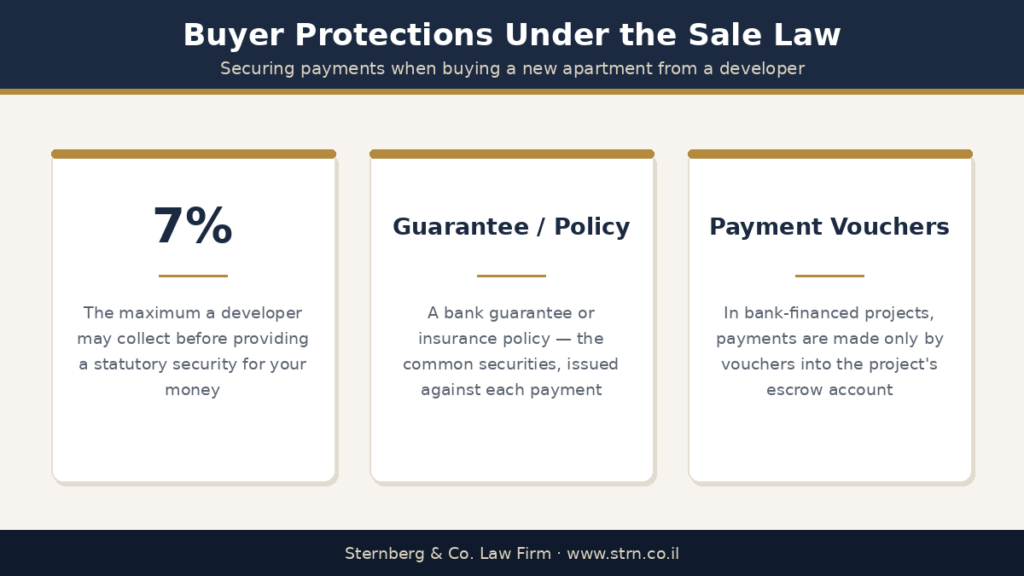
The Sale (Apartments) (Assurance of Investments of Apartment Purchasers) Law prohibits a seller from receiving more than seven percent of the apartment price from a buyer without providing a lawful security. The common securities are a bank guarantee (the “Sale Law guarantee”) or an insurance policy; the law also recognizes additional securities under certain conditions, including a charge, a cautionary note or registration of rights – whose nature and the scope of protection they provide differ materially.
In a project under bank accompaniment, payments are made by means of a payment voucher booklet, directly into the project’s accompaniment (escrow) account, and a guarantee must be issued against each payment. A payment made other than by voucher – for example, directly into the developer’s account – may leave the money unprotected. As part of the legal representation, we review the type of security offered, the wording of the guarantee, the mechanism for its delivery to the buyer, and the alignment of the payment dates with the actual receipt of the securities.
Indexation to the Construction Inputs Index – the Limits After Amendment 9
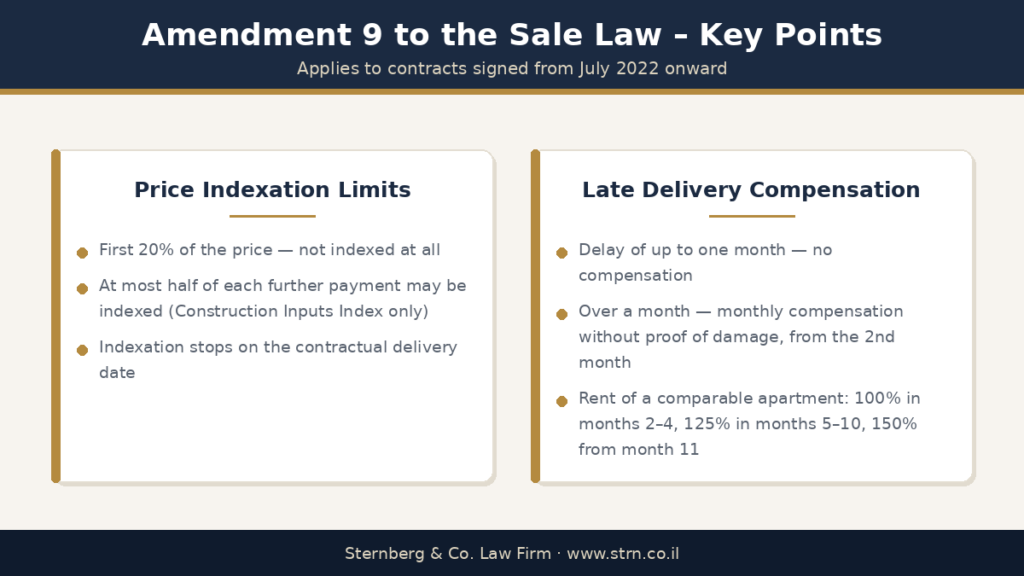
In the past, developers customarily linked the entire balance of the price to the Construction Inputs Index, at times adding substantial amounts to the apartment price. Amendment No. 9 to the Sale (Apartments) Law, which came into force in July 2022 and applies to contracts signed thereafter, changed the picture: the first twenty percent of the apartment price is not indexed at all; at most half of each further payment may be indexed, and only to the Construction Inputs Index; and indexation stops on the contractual delivery date – so that late delivery does not “roll” additional indexation onto the buyer, except in exceptional circumstances set out in the law.
Reviewing the indexation mechanism in the contract, its compliance with the Amendment and a simulation of its financial implications are an integral part of the contract review.
Late Delivery of the Apartment – Compensation Without Proof of Damage
Late delivery is one of the most common breaches in purchases from developers. The law establishes a compensation mechanism that requires no proof of damage: in contracts signed on or after July 7, 2022 (following Amendment 9), a delay of up to one month from the contractual delivery date does not entitle the buyer to compensation; however, a delay exceeding one month entitles the buyer to monthly compensation, paid at the end of each month, starting from the second month: for the second through fourth months – compensation equal to the rent of a comparable apartment in size and location; for the fifth through tenth months – 125% of such rent; and from the eleventh month onward – 150%. The developer is exempt from compensation only in narrow circumstances: where the buyer caused the delay, or in circumstances of frustration of the contract that could not have been foreseen.
In practice, enforcing the right to compensation often requires legal handling vis-à-vis the developer – including documenting dates, rebutting claims of “circumstances beyond the seller’s control” and exercising caution before signing waivers at the delivery stage. Developers’ offers to convert the compensation into upgrades or credits require careful financial and legal scrutiny – particularly for buyers abroad, who are not present to monitor the project’s progress.
Delivery of the Apartment: Form 4, Delivery Protocol, Warranty Periods
Delivery of the apartment is conditional on the existence of Form 4 (the occupancy certificate) and on the apartment conforming to the contract and the specification. At delivery, a delivery protocol is drawn up, documenting the defects and non-conformities identified. It is advisable to engage a professional home inspection (bedek bayit) before delivery, and to ensure that the protocol reflects all findings – without including a waiver of future claims, since some defects by their nature only become apparent during the period of occupancy.
After delivery, the warranty (bedek) and guarantee periods under the Sale (Apartments) Law apply, during which the developer is obligated to repair defects according to their type. For more on this subject, see our Construction Defect Lawyer in Israel practice page and the legal guide to construction defects in Israel.
Taxation When Buying from a Developer
The price of an apartment purchased from a developer includes VAT, and the purchase is subject to purchase tax (mas rechisha) according to the buyer’s circumstances – including the distinction between a single residential apartment and an additional apartment, and special arrangements for new immigrants (olim) and foreign residents. In certain transactions, the manner in which the components of the deal, custom changes and buyer modifications are presented also carries tax significance. As part of the legal representation, the expected tax liability is assessed, the declarations are filed with the tax authorities on time, and eligibility for reliefs or exemptions is examined according to the buyer’s circumstances.
Registration of Title in the Buyer’s Name
The final stage – and at times the most prolonged – is the registration of the condominium and the registration of title to the apartment in the buyer’s name at the Land Registry (Tabu) or the Israel Land Authority. The sale contract should set clear timetables for registration and anchor the developer’s undertakings, and as part of the representation we verify that, until registration, the buyer holds appropriate protections – including a cautionary note or another lawful security – and that upon completion, title is registered free of any charge.
Legal Representation When Buying from a Developer
Sternberg & Co. is a boutique civil and commercial litigation firm that handles real estate transactions with a forward-looking, litigator’s perspective: a good contract is tested not only on the day of signing, but on the day a dispute arises. Representing a buyer purchasing from a developer requires attention to the following:
- Due diligence on the developer, the contractor, the land rights, the building permit and the bank accompaniment;
- Negotiation of the sale contract, the technical specification and the annexes, and correction of clauses that deviate from the law;
- Oversight of the securities under the Sale Law, the payment voucher booklet and the payment schedule;
- Handling the tax aspects and the registration of title through to its completion;
- Representation at the delivery stage, including late delivery, the delivery protocol and construction defects;
- And where required – representation in legal proceedings against the developer, drawing on hands-on litigation experience in real estate and construction matters.
The firm’s experience representing developers, construction companies and contractors, alongside representing buyers – including in complex transactions such as buying property from a receiver – provides a practical advantage in identifying the real risk points in developer sale contracts and in conducting focused, substantive negotiations. For our main real estate practice page: Real Estate Attorney in Israel.
Buying an apartment from a developer in Israel? It is advisable to seek legal representation before signing a purchase request or any other binding document. Contact us to schedule an initial consultation.
The above is general information only and does not constitute legal advice or a substitute for specific legal advice. In any concrete case, it is recommended to seek legal advice according to the circumstances.